

(un)learning
urbanity
symposium
Symposium for emerging critical urban studies and practice
19-21 June 2026
free entry, donations appreciated
About the symposium
A space beyond the academic
From June 19–21, 2026, the (re)searching urbanity collective is hosting its third symposium at the Floating University in Berlin-Kreuzberg. Under the title “(un)learning urbanity”, the symposium invites participants to collectively reflect on current urban realities through the lens of unlearning – questioning familiar and normative ways of thinking and practicing, to create space for more solidaric, climate-conscious, and community-oriented forms of urban futures. The event is conceived as a shared space for learning and reflection, bringing together different forms of knowledge, experience, and practice.
The program is based on an open call and features more than 30 contributions by emerging and more established voices from the fields of art, research, and urban practice. It includes workshops, talks, and exhibitions across the three-day program.
The symposium is free of charge (donations are welcome) and open to everyone. As an open format, visitors are welcome to drop by spontaneously and engage with questions of urban coexistence, regardless of prior knowledge or background. Program contributions will be held in both English and German.
What to expect
Talks
Short, focused presentations by researchers and practitioners from diverse fields
Workshops
Panels
Exhibitions
Program
Friday, 19.06
17:00
Opening of the exhibition (all exhibitions are available throughout the entire symposium weekend)
EN / Drifting Tea Open Spatial Intervention & Tea Offering, Miu Onoda (she/her), Ku Yoshitomi (he/him)
Drifting Tea explores how small sensory practices can open up lighter ways of relating to place in the city. It responds to the experience of transient citizens: people who live with temporary, shifting, or partial connections to urban environments, somewhere between visitor and resident.
The project asks how public and shared spaces might support subtle forms of presence. Through tea serving and tea making, participants are invited to pause, notice their surroundings through the senses, and leave a postcard reflection.
The project treats relation to place as something that may be brief, incomplete, and still forming. Drifting Tea invites people to stay lightly, and to notice how urban places are felt through small encounters, materials, and moments of pause.
DE / Gegen-/Architekturen der Sexarbeit, Beverly Engelbrecht (she/her)
Eine Serie von zehn großformatigen, spekulativen Buntstift-Zeichnungen, die ich im Kontext meines Promotionsprojekts ‚Gegen-/Architekturen der Sexarbeit. Das Beispiel der Potsdamer Straße und assoziierter Orte in West-Berlin‘ anfertigte, untersucht Räume und Raumproduktionen von Sexarbeiter*innen und weiteren relevanten Akteur*innen.
In den Zeichnungen rekonstruiere ich anhand von zehn Fallstudien, die ich in meiner Dissertation weiter ausführe: den Straßenstrich (1980), das ‚Hotel Potsdam‘ (1985), den ‚Nachtfalter und die Sexy-Bar‘ (1974), den ‚Club Metress‘ (1980), eine von Sexarbeiterinnen geteilte Wohnung (1980), eine ‚Zufluchtswohnung‘ für asiatische Sexarbeiterinnen (1989), ein instandgesetztes Haus (1981), den Drogennotdienst ‚Olga‘ (1988), die ‚Anwohnerinitiative Lützowstraße‘ (1992) und die Aktion ‚Bockscheine für Freier‘ (1989).
Bei den Zeichnungen handelt es sich um Schnitt-Axonometrien. Grundlage bilden heterogene, teils fragmentarische Materialien (Karten, Bauakten, Fotografien sowie Interviews). Da die Gegen-/Architekturen nicht vollständig rekonstruierbar sind, arbeite ich in der Serie bewusst spekulativ und schließe Leerstellen. Durch verschränkte Maßstäbe hierarchisierte ich Informationen. So fokussiere ich mittels Nahsichten Körper und Interaktionen und nutze weitere Maßstäbe für Raum-Zusammenhänge. Ziel der Serie ist es, vertraute Darstellungsmethoden und die Selbstverständlichkeit dessen, was als untersuchungswürdig gilt, zu hinterfragen.
EN & DE / recovery / resilience from violent regimes – Shared Knowledge Spaces for collective Imagination on Biodiversity participatory installation, Polyphonic Dreems, Jil (they)
Du kommst in einen Raum, berührst das Moos und tauchst ein in Geschichten von 100 Jahren lokaler Umweltzerstörung und Biodiversitätsverlust. Es erzählt davon, wie die ökologische Nachbar*innenschaft immer homogener geworden ist, weil viele mit den lokalen Umständen und giftigen Rückständen nicht mehr zurechtkamen. Es erzählt aber auch die ungesehenen Perspektiven von Versuchen, gegen allgegenwärtige Zerstörungswut kollektive Antworten zu finden.
Recovery / Resilience from Violent Regimes ist ein multisensorischer Lernraum, der Geistern der Vergangenheit und den Geistern der Zukunft einen Platz bietet. Dabei steht das Moos als lokale Träger*in der Erinnerung und Akteur*in ungesehener Carearbeit für die Renaturierung von Böden im Mittelpunkt. Gleichzeitig werden auch die Besuchenden nach ihren Erinnerungen zu Veränderungen und Erfahrungen mit lokalen Ökosystemen befragt, sodass die Arbeit als wandernde Installation ein wachsendes Archiv der Erinnerung für Klimagerechtigkeit und ökologische Konfliktarbeit wird.
EN / How we read a city: perception of a place installation, Lea Hasenkamp (she/her)
Before navigation became digital, cities were read differently. In Prishtina (Kosovo), orientation often relied on shared references, stories, and everyday descriptions rather than addresses or maps. Places were described through what happens there, what is remembered, or who is connected to them.
These situated ways of navigating still persist, yet they are increasingly overlaid by standardized digital systems. With this shift, not only routes change, but also attention: what becomes visible, relevant, and worth remembering.
Two large-scale drawings translate this transformation into a spatial comparison. Both depict the same site and scale. One follows a reduced cartographic logic. The other interrupts this structure through layers of marks, symbols, and short narrative traces—pointing to events, informal uses, and personal references that escape standardized representation.
What emerges is not a contrast between objective and subjective views, but a tension between different ways of reading the city—coexisting, overlapping, and gradually displacing one another. A short essay extends this approach through a more narrative lens.
EN & DE / urban space as a living archive. Moments of resistance and healing poster presentation, Fee Wüstenberg (she/her)
What happens when an urban space remembers differently? This poster engages with the initiative to rename Berlin’s Hermannplatz as Hind Rajab Place — a practice of bearing witness that inscribes memory, responsibility, and visibility into urban space. In a city where street names predominantly commemorate white, heterosexual men, the intervention disrupts dominant regimes of remembrance and asks: Whose lives are considered grievable? How can healing emerge through the reclaiming of space and resistance against forgetting?
Hind Rajab (2018–2024) was a five-year-old Palestinian girl killed in Gaza in 2024. Her name now travels through protest and collective remembrance into the urban space. The project asks whose lives are publicly grieved and remembered — and how counter-archives can create new forms of belonging. The PhD project Contested Memories in Urban Spaces at the European University of Flensburg investigates the city as a living archive that is continuously rewritten through activist practices — and as a site of decolonial and queer-feminist learning.
EN / Veiled Memories installation, Nicole Hipp (she/they)
During feminist protests, the city changes its skin. Walls, monuments, and public buildings fill with graffiti, posters, and accusations written in anger. For a brief moment, the city becomes a collective voice. Then it gets painted over. Veiled Memories emerged from this feeling of helplessness. Since 2022, Nicole has been collecting these images: photographs quickly taken during protests in Mexico City and Berlin, screenshots, traces that existed only briefly on walls and posters before surviving only inside our phones. For this installation, Nicole printed these images onto fragments of industrial debris — concrete, wood, and discarded materials. Objects that feel like rescued pieces of the street, saved before erasure. If you look closely at the objects, you will notice the pixels. The blurriness. These are not physical graffiti brought indoors, but digital traces collected over years through phones, screens, and the circulation of protest across the internet. From walls to phones to physical objects — this journey is part of the work itself. Veiled Memories asks what it means to preserve what cities attempt to forget and to give a permanent body to something that was never meant to last.
EN & DE / Grieving Doves: Whose Lives are Seen installation, Grieving Doves
Grieving Doves is an open Berlin-based initiative that honours Palestinians killed by Israeli violence and stands for the liberation of Palestine. Since 2023, the group has gathered almost weekly to write the names and ages of those killed in Gaza, by hand, in community, on pieces of fabric, sewing them onto wings carried in public actions, at demonstrations and interventions, to honour and mourn each one.
To date, over 26,000 names have been written. In Germany, where Palestinian grief is often marginalised or suppressed, this collective practice of mourning refuses the erasure of lives and disrupts narratives that seek to justify mass killing. It asks the city to look and to feel, rather than turn away.
At the symposium (un) learning urbanity, Grieving Doves presents a selection of these wings and sewn names, alongside Filastin, a large-scale dove assembled from hundreds of name-bearing fabric pieces , and photographic documentation of their actions in public space. Together, these works bring grief into the city, unsettling its selective memory and exposing the politics of visibility.
By carrying names into urban space, the project reclaims the city as a site of mourning and resistance. It invites a process of unlearning: to recognise the lives being lost , and the structures that make their loss possible.”
DE / Stadt der Freund*innen – konkrete Utopien für ein ‚anderes‘ Zusammen-Sein in Berlin multimedia, Teilnehmende des Tutoriums „Stadt der Freund*innen“ und Marieke Fischer
Krisen wie Gentrifizierung, zunehmende soziale Isolation und Konflikte um öffentlichen Raum verschärfen sich in Berlin. Diese Herausforderungen verlangen nach neuen Denkweisen – nach Ansätzen, die Verbindung, Sicherheit und Hoffnung in den Mittelpunkt stellen. Inspiriert von (queer-)feministischen Perspektiven versteht dieser Ausstelleungsbeitrag Freund*innenschaft als konkrete Utopie und subversive Praxis: als Möglichkeit, Zugehörigkeit zu schaffen und Netzwerke gegenseitiger Unterstützung aufzubauen. Während Stadtplanung und Politik weiterhin romantische Beziehungen und heteronormative Kleinfamilien privilegieren, untersucht der Workshop freundschaftsbasierte Lebensweisen als zukunftsweisende Alternative für urbanes Zusammenleben. Gemeinsam fragen wir: Welche konkreten utopischen Vorstellungen entstehen, wenn Menschen hegemoniale Stadt- und Machtstrukturen hin zu einer von Freundschaft geprägten Stadt öffnen? Wo entstehen Momente des Bruchs mit dem Vertrauten, in denen mögliche Zukünfte bereits in der Gegenwart sichtbar werden? Welche Potenziale und Grenzen liegen darin, Freund*innenschaft im Verhältnis zu urbanem Raum neu zu denken?
EN / Playful Inclusion multimedia, Saba Barani (she/her)
This contribution builds on the Playful Inclusion research group and engages (un)learning as a collective, critical, and playful process for rethinking urbanity from a post-migrant perspective. It starts from the premise that dominant notions of “home” and “belonging” are often fixed, exclusionary, and spatially bounded, and thus require active unlearning. The workshop and exhibition invite participants to rethink normative understandings of home by exploring diverse, situated, and often fragmented practices of home-making. Particular attention is given to how temporalities and socio-political conditions shape experiences of belonging across different groups.
The format is a collaborative mapping process. A map installation serves as a shared surface where both workshop participants and exhibition visitors contribute. Through guided prompts and examples, participants will map personal narratives, spatial practices, and affective dimensions of home across scales—from the body to the neighborhood and beyond. This unfolds through two modes: facilitated workshop session and open, ongoing exhibition contributions. In parallel, participants co-create an inclusive, evolving glossary that challenges dominant vocabularies of home, belonging, and urban life, capturing plural meanings,contradictions, and emerging concepts.
Re-use Commons Student Housing film, Püren (she/her), Jonathan (he/him), Jesco (he/him)
Campus as Commons explores how underused university buildings can be transformed into affordable, commons-based student housing. The project combines design, construction, and research in a transdisciplinary format at TU Berlin.For this contribution, we present excerpts from an ongoing documentary film project that accompanies the process. Rather than a finished film, the material offers a raw insight into the making of the project: scenes from the workshop and building process, spatial experiments in the former mathematics building, and moments of collective construction with students from TU Berlin as well as international participants from Gdańsk and Milan. The footage captures both hands-on construction and reflective moments, where participants discuss their ideas on reuse, collective living, and alternative housing models. It documents the emergence of the project as a student-led initiative that moves between architectural practice, political questions and commons-based approaches to space.
EN / Mapping Postmigrant Landscapes: Traces of Marielle Franco's Legacies in Berlin Urbanism exhibition, Ingri Berns Pavezi (they/them)
The exhibition maps the visual traces of Marielle Franco’s presence within Berlin’s postmigrant urban landscape. Marielle Franco was a Black, lesbian Brazilian woman, activist, sociologist, and human rights defender, assassinated for political reasons in 2018. Her death mobilized global solidarity, including within Berlin’s Brazilian community and its allies. They ensured that she was not forgotten and sent a clear message of solidarity and strength to Brazil, worldwide, and to the neighborhoods of Berlin. Today, those echoes have become an integral part of the urban landscape of Berlin. Through photographs and portraits, we invite you to consider: How does a post-migrant presence shape our cities? How can transnational solidarity influence our daily spaces, and which struggles are incentivised—or censored—today? Ultimately, how are memory and belonging transformed by the renaming of Berlin’s public and semi-public spaces?
This work is dedicated to the Brazilian community in Berlin. My 11 years with you have convinced me that home is where we dwell; as such, we must care for it through presence, justice, joy and solidarity with our neighbouring communities, whether global or local. The exhibition is a partial result of my work as a guest researcher for the Postcolonial Neighborhoods project, funded by the DFG and based at the Institute of European Ethnology at Humboldt University.
DE / rest is resistance x stitching feminist futures interactive installation, Frieda Grimm (she/her), Johanna Köck (she/her)
Der Teppich ist eine Einladung, zusammenzukommen, sich im Laufe des Symposiums auszuruhen und über bestimmte Fragen rund um Zugänge und Ausschlüsse der Erholung nachzudenken. Wie könnte eine Neuorganisation von Räumen der Erholung und Fürsorge zugunsten marginalisierter Menschen aussehen? Inspiration waren die Nap Events von Tricia Hersey und ihr Buch „Rest is Resistance“.
Stitching Feminist Futures ist ein textiles, kollektives Skizzenheft über Gedanken, Motive und Forderungen rund um eine feministische Bauwende.
Im gemeinsamen Sticken entsteht Raum für Begegnung, Austausch und Vernetzung. Der Stoff ist ein fragmentarisches Dokument der Vielen und ist inspiriert von Kollektiv Sticken und anderen stabilen Feminist*innen.
19:00
Opening Panel, 60 min
Description will be added later
Saturday, 20.06
11:00
EN / City of friends - envisioning concrete utopias together workshop, 120 min
Marieke Fischer (she/her)
Marieke Fischer (she/her)
Crises such as gentrification, growing social isolation, and conflicts over public space are intensifying in Berlin. These challenges call for new ways of thinking – approaches that foreground connection, safety, and hope. Inspired by (queer-)feminist perspectives, this workshop places friendship at the center of a concrete utopia: as a subversive practice that fosters belonging and builds networks of mutual support.
While urban planning and policy continue to privilege romantic relationships and heteronormative nuclear family models, this workshop explores the possibilities of friendship-based ways of living as a forward-looking alternative for urban life.
By imagining a ‘city of friends’, we will engage with questions such as: What kinds of concrete-utopian imaginaries emerge when people come together to open up hegemonic urban and power structures toward visions of a city shaped by friendship? Where do moments of disruption occur – ruptures with the familiar that allow seemingly future possibilities to already take shape in the present? What potentials lie in rethinking friendship in relation to urban space and ways of being – and where are its limits?
In this creative workshop, we will explore these ideas collectively through conversation, writing, mapping, and collage. No prior knowledge is required – only a curiosity and willingness to envision an-other(ed) kind of city together.
DE / Stadt vs. Land- Rechte Großstadtfeindlichkeit und romantisierte Naturvorstellungen workshop, 120 min
Fine (she/her)
Fine (she/her)
Die Ablehnung der Großstadt ist im rechten Spektrum kein zufälliges Phänomen – sie ist Teil eines ideologischen Weltbildes, das kulturelle, politische und gesellschaftliche Aspekte miteinander verbindet. Städte werden dabei häufig als Orte von Internationalismus, Liberalismus und kulturellem Wandel dargestellt – als Räume von Vielfalt und Veränderung, die als Gegenbild zu einer vermeintlich homogenen und überschaubaren Lebensweise auf dem Land dienen. Historisch war diese Ablehnung von Großstädten zudem eng mit antisemitischen Einstellungen und Verschwörungsnarrativen verknüpft.
Urbane Probleme wie steigende Mieten oder soziale Ungleichheit werden von rechten Akteur*innen gezielt aufgegriffen und politisch umgedeutet. Die Wohnungsfrage erscheint dabei nicht als strukturelles Problem, sondern wird in Narrative eingebettet, die auf Abgrenzung und Ausschluss zielen. So entstehen Deutungen, in denen Vielfalt als Bedrohung erscheint und eine idealisierte ländliche Idylle als Gegenentwurf inszeniert wird.
12:00
13:00
EN / Beyond Expertise: What can children teach us about space? lecture + station, 60 min
assemble.berlin (them)
assemble.berlin (them)
What if we posed the routine questions of design and listened—without judgment—to those who did not yet receive formal training? What urban imaginaries might emerge? At Assemble Berlin, we (un)learn urbanity alongside children in architecture and urban design workshops. Launched in 2022 amid Russia’s full-scale invasion of Ukraine and the arrival of refugee families with kids, our project equips kids with tools to shape space on their own terms, free from theoretical preconceptions.
We will present our experiments and reflections on conventional design methodology, as well as the projects designed by kids during our workshops. These projects challenge our familiar frameworks with bold, unburdened visions—revising the hierarchies in urban space, creating funky and bizarre forms born of curiosity and play.
What biases and stereotypes can we unlearn if we let kids guide us? How will our practice change if we stop fearing mistakes and start engaging in game and experiment? Could reprogramming our ways of thinking result in creating more inclusive and just urban spaces? We will examine these questions during our talk and test them at our station using the “what if…” drawing-without-limits exercise.
EN / Playful Inclusion, Unlearning Home workshop, 120 min
Saba Barani (she/her)
Saba Barani (she/her)
This contribution builds on the Playful Inclusion research group and engages (un)learning as a collective, critical, and playful process for rethinking urbanity from a post-migrant perspective. It starts from the premise that dominant notions of “home” and “belonging” are often fixed, exclusionary, and spatially bounded, and thus require active unlearning.
The workshop and exhibition invite participants to rethink normative understandings of home by exploring diverse, situated, and often fragmented practices of home-making. Particular attention is given to how temporalities and socio-political conditions shape experiences of belonging across different groups.
At the core is a collaborative mapping process. A map installation serves as a shared surface where both workshop participants and exhibition visitors contribute. Through guided prompts and examples, participants map personal narratives, spatial practices, and affective dimensions of home across scales—from the body to the neighborhood and beyond. This unfolds through two modes: facilitated workshop sessions and open, ongoing exhibition contributions.
In parallel, participants co-create an inclusive, evolving glossary that challenges dominant vocabularies of home, belonging, and urban life, capturing plural meanings, tensions, and emerging concepts.
14:00
EN & DE / Spheres of Post-Urban Spaces 8 Essays and 4 Conversations, 60 min
Lorenz Krauth (no pronouns)
Alexander Mehren (he/him)
Lorenz Krauth (no pronouns)
Alexander Mehren (he/him)
spheres collates perspectives on spatial and urban matters. As a community platform, spheres enables synergetic momentum amongst practices and authors – who all come from diverse practices. The narratives of these formats encourage the scrutinising of social, ecological, and spatial paradigms. Evolving from collective work amongst a group of friends since 2023, and a context of urban and architectural discourse, spheres weaves its content into this European network of critical positions.
Our first anthology, published by botopress in February 2026, introduces ‘post-urban spaces’ as a refreshing concept in urban practice. Ideas of modernity are outdated. We can only respond to the multifarious crises of urbanised societies if we begin to see the interconnectedness of city and countryside, humans and nature. Then, we can ask ourselves: what to do with this knowledge?
Our essays and conversations portray disruptions in the urban system, the blind spots in the field, the holes in the fence, places that offend the top-down programmes of urban governing. The Right to the City reverberates and re-occurs as the Right to Discontinuities today. When applied, it produces post-urban spaces, which have the potential to allow the emergence of new social bonds, spontaneous encounters, and places of proximity. These spaces – whether physical or virtual – can only be produced through constant negotiation.
15:00
EN / Preservation in a Living Megacity: Towards Co-Creative Heritage Practices in Old Dhaka talk, 60 min
Khandoker Upama Kabir (she/her)
Khandoker Upama Kabir (she/her)
Old Dhaka is one of the oldest and most densely inhabited parts of a megacity that is still shaped by living cultural practices, layered histories, and everyday negotiations of space. Yet its built heritage is often approached through expert-driven and preservationist frameworks that leave little room for community agency, trust, or collective imagination. This talk reflects on my research on neglected historic sites in Old Dhaka and asks how co-creative artistic practices might help rebuild relationships between people and built heritage. Drawing on comparative examples from Bangladesh and beyond, I explore how heritage can be understood not as a fixed object to be protected, but as a relational and evolving urban process.
EN & DE / Beyond the Binary input + reflection, 120 min
Marko Hüsch (he/him)
Marko Hüsch (he/him)
Sobald wir unsere Körper entkleiden, fordern uns räumliche Strukturen explizit auf, uns in weiblich oder männlich einzuteilen. Indem wir uns regelmäßig zwischen links oder rechts entscheiden, verinnerlichen wir diese räumlichen Prozesse und machen sie zu einer alltäglichen Choreografie. Egal, ob dies bewusst oder unbewusst erlebt wird: Geschlechtsspezifische Räume machen Genderidentitäten in vielen Situationen sichtbar und adressierbar. Für einige ist dies nicht weiter nennenswert, für andere eine tägliche Konfrontation. Binäre Raumstrukturen wirken kategorisierend und differenzierend; sie können bestätigen oder verunsichern.
Wenn wir körperliche Selbstbestimmung und Genderdiversität als gesellschaftliche Güter anerkennen, stellen sich Fragen in Bezug auf diese Form binärer Aufteilung. Welche geschlechtsspezifischen Strukturen wurden an welchen Zeitpunkten der Geschichte wie in Architekturen eingeschrieben? Die Wechselwirkung aus etablierten Normen, genutzten Bildsprachen und gelebten Sozialräumen ist hierbei relevant. Interessant scheint es, in Abwägung verschiedener Bedürfnisse progressive Modelle zu entwickeln, die Inklusion fördern und stereotype Muster abbauen.
Gemeinsam werden wir abwechselnd in Input- und Reflexionsrunden der Frage nachgehen, über welche Ebenen Gender räumlich strukturiert wird und welche Lösungen heute möglich sind. Die Inhalte beziehen sich auf das Seminar ‚Gender Gaps‘, das im Wintersemester 2025/26 an der UdK Berlin stattgefunden hat.
16:00
EN / city-wastescapes interactive talk, 60 min
juls sába (she/they)
juls sába (she/they)
The project builds on my research on waste collection systems in Buenos Aires, exploring how urban residents can actively evaluate the quality of public infrastructure. Rather than presenting finished results, I frame it as a participatory inquiry inviting collective reflection on our everyday relationship with waste.
The session combines short surveys, discussion prompts and visual storytelling. Participants will reflect on how waste appears in their daily urban experience, how visible or invisible collection infrastructures are and what mechanisms exist (or are missing) for citizens to assess service quality.
I developed a composite indicator to measure waste collection quality across different socio-economic areas of Buenos Aires. Using geospatial analysis and mapping, the project explored how uneven infrastructure intersects with urban justice, while investigating citizen participation as a mechanism of accountability – positioning residents not only as service users but as evaluators of urban systems.
Within Unlearning Urbanity, the proposal adopts a speculative design perspective: instead of asking how cities optimize waste management, it asks how alternative relationships to waste, data and public responsibility might be imagined. By bringing a case from the Global South into dialogue with Berlin and other cities, it opens questions about who measures infrastructure quality, whose knowledge counts and how participatory practices could reshape public service governance.
17:00
DE / Surpassing the Lines: Kartieren queerer Erfahrungen im urbanen Raum presentation, 60 min
Lino Schröder (he/him)
Lino Schröder (he/him)
Der öffentliche Raum ist von sozialen und politischen Machtstrukturen geprägt, die eine ungleiche Verteilung von Gütern und Ausschlüsse von marginalisierten Gruppen hervorrufen.
Eine der Gruppen, die im öffentlichen Raum mit Herausforderungen, wie Barrieren und Diskriminierung, konfrontiert werden, bilden LSBTQIAP+ Personen. Trotzdem sind LSBTQAIP+ Personen schon immer aktive Ak_teurinnen, die sich ihre Räume aktiv selbst schaffen und sich nicht verdrängen lassen. Dabei kommen sowohl alltägliche Praktiken, als auch offener Protest zum Einsatz.
In dem Vortrag „Surpassing the Lines: Kartieren queerer Erfahrungen im urbanen Raum“ werden Auszüge erlebter Wahrnehmungen und Erfahrungen von trans* und nicht-binären Personen im öffentlichen Raum, auf Grundlage von Interviews aus 2023, thematisiert.
Desweiteren werden mögliche Einfluss-Faktoren und die im Rahmen eines Workshops angewandte Methode des Skizzierens von kognitiven Karten in Hinblick auf Empowerment und die Kommunikation von Bedürfnissen im öffentlichen Raum diskutiert.
In meinem Vortrag spreche ich über die Ergebnisse meiner gleichnamigen Bachelorarbeit „Surpassing the Lines: Kartieren queerer Erfahrungen im urbanen Raum“ und lade zu einem gemeinsamen Austausch und Diskussion zu Themen wie Machtstrukturen, empowernde Praktiken und Praxisbeispiele im öffentlichen Raum ein.
DE / Zentrum Raum: Skillbörse 3.0 workshop, 180 min
Zentrum Raum e.V.
Zentrum Raum e.V.
Bei der Zentrum Raum Skillbörse werden den Teilnehmenden durch die professionellen Workshopleitenden essenzielle Skills und Hidden-Knowledge zur subversiven Stadtaneignung an die Hand gegeben. Dabei gelten zwei Regeln. Erstens: Das Wissen, was ihr hier vermittelt bekommt, findet ihr sonst in keinem Workshop, denn es kommt direkt von der Straße. Zweitens: Was ihr damit macht, liegt in eurer Verantwortung. Gemäß dem Thema „(un)learning urbanity“ lernt ihr auf der Zentrum Raum Skillbörse Alltägliches zu sabotieren, zwischen ausgetretenen Pfaden neue Wege zu finden und euch die Räume zwischen den Räumen zu eigen zu machen.
In den Workshops wird auch dieses Mal wieder eine große Bandbreite an Fähigkeiten und Know-how vermittelt: Vom Craftingworkshop „Von Entführung bis Zombieapokalypse: Wie man sich selbst eine Strickleiter knüpft“ über das actionreiche Format „Zäune – Wenn wir nicht drüber klettern können, flexen wir das Scheißding eben auf“ bis hin zum Inputvortrag „Das ist unser Haus! Wie schaffe ich eine Infrastruktur beim Squatting“ ist für jede*n etwas dabei. Die Workshops dauern jeweils eine Stunde und werden zeitgleich angeboten. Nach einer Pause von 15 Minuten werden sie noch einmal wiederholt. Ihr habt so die Möglichkeit, an bis zu zwei der Formate teilzunehmen und im Anschluss mit einer Bandbreite neuer Fähigkeiten zurück in die eigene politische Arbeit zu starten.
18:00
EN / What potatoes have to do with revolution presentation, 60 min
Snackbar Frieda
Snackbar Frieda
Snackbar Frieda is a squatted snackbar in the centre of Rotterdam, NL. By creating a commons through sharing our space as well as the redistribution of (discarded) food with our neighbours and various marginalized and radical communities we try to create a community that breaks the cycle of neoliberal capitalist realism, promoting and normalising radical methods of direct action and mutual aid in the process.
19:00
Sunday, 21.06
11:00
EN / The Centre for the Just City workshop, 120 min
Gosia Rybak (she/her)
Wanda Wahl-Mertes (she/her)
Andria Charlilaou (she/her)
Gosia Rybak (she/her)
Wanda Wahl-Mertes (she/her)
Andria Charlilaou (she/her)
The “default city” operates through norms that privilege certain bodies, mobilities, and ways of inhabiting space while rendering others invisible or out of place. A city is not a collection of standardized people but a constellation of relations and lived experiences. It is inherently complex. Through intersectional and embodied mapping, this workshop invites participants to collectively reimagine the default city by critically engaging with established spatial norms and embracing plural spatial experiences.
We begin with an embodied warm-up to foster an atmosphere of trust and togetherness. From there we engage in a positionality exercise, mapping how power dynamics shape everyday spatial experiences. These reflections feed into the main counter-mapping exercise: working with a base soft map we reimagine spatial arrangements through our needs, desires, and lived perspectives using crafting, writing, mapping. The workshop ends with something tangible, a collective soft map that makes our hidden urban stories visible.
Counter-mapping is not only reflective, but disruptive. We invite you to move with us towards playful and insurgent spatial imaginaries!
*As Urbanists bonded by spatial justice curiosities we bring three perspectives: Wanda explores decolonial spatial practices; Andria engages with feminist urbanism; Gosia works with queering spatial planning and intersectionality. This workshop emerges from our shared involvement with the Centre for the Just City.
DE / Physische Präsenz als inklusive Praktik? Über gefühlte Zugänglichkeit zu und gefühlte Sicherheit in öffentlichen Räumen workshop, 120 min
think SI3
think SI3
Physische Präsenz in öffentlichen Räumen ist eine zentrale Voraussetzung gesellschaftlicher Teilhabe. Entsprechend sollte die gefühlte Zugänglichkeit zu eben diesen vor allem auch für marginalisierte Gruppen gestärkt werden. Zugleich sind die Wahrnehmungen von (Un-)Zugänglichkeiten subjektiv, prozessual und kontextspezifisch. Sicherheit spielt eine entscheidende Rolle in der Debatte über die (Verbesserung) der wahrgenommenen Zugänglichkeit öffentlicher Räume. Bauliche, gestalterische Interventionen sind nur bedingt als Lösungen zu verstehen, da sie oftmals nur bestehende gesellschaftliche Verhältnisse und Normen widerspiegeln. Welche anderen Ansätze können also verfolgt werden, um die gefühlte Zugänglichkeit öffentlicher Räume für marginalisierte Gruppen zu stärken? Inwiefern kann eine physische Präsenz ansprechbarer und intervenierender Akteur*innen hier unterstützend wirken? Und wo liegen die Grenzen dieses Ansatzes?
Im Zentrum des Workshops steht eine Auseinandersetzung mit gängigen Ansätzen zur Gestaltung öffentlicher Räume. Anstelle rein baulicher oder gestalterischer Maßnahmen wird der Blick auf soziale Interventionen gelenkt: Diskutiert wird die Rolle von Mediator*innen als niedrigschwellige, dialogorientierte Ansprechpersonen in öffentlichen Räumen.
EN / 11:30 Werk like Drag workout / athletic intervention, 90 min
Feminist Spaces Collective
Feminist Spaces Collective
Workout like FLINTA* is a sport-based artistic intervention in public calisthenics parks in Berlin – spaces traditionally coded as masculine, competitive, and performance-oriented. The project invites FLINTA* people to work out together and collectively create an environment of care, visibility, and mutual support.
For the symposium, we propose a special edition titled “Werk like Drag”, in which the workout is hosted by Drag Artists. Through drag performance, collective movement and sport games public space it becomes a site where boundaries between sport and art, discipline and play overlap and dissolve. The Drag Artists lead the workout while expanding it beyond functional exercises. Inclusion of performances, dance, games, and humor open the space to multiple forms of expression.
By inhabiting the public space differently, we (un)learn its social and symbolic boundaries: who belongs here, how bodies move, and which behaviors are considered appropriate.
The concept of the workout session for the symposium is “relay race day” (Veselye Starty” – lit. “Merry Starts”). It is a team relay competition, where two teams compete in a series of fun athletic relay races – running, jumping, balancing, and other challenges.
These workout sessions will be open for all bodies and genders.
The duration of the workout session is ~1 hour.
12:00
13:00
EN / (un)learning public space through re:connection talk, 60 min
spatial cru
spatial cru
How do we restore our relationships with public spaces and co-create other ways of connecting with/in them? How do we (un)learn from the everyday and what do we become when we sense the city more closely? These questions have guided a series of workshops conducted by the spatial.cru collective in 2025-26, bringing together human and more-than-human participants. The workshops propose an embodied dialogue with our environment through walking, listening, smelling, touching, wishing, noticing and slowing down in different areas of Berlin and in different seasons. These sensory acts translate into drawings, recordings, collective exchanges and memories that create traces of new connections between bodies and space and reflections on forgotten ones. In this talk, we discuss these experiences and how (un)learning public space through re:connection can be a form of knowledge production grounded in recognition and embodied experience. These co-creative acts lead to a rethinking of public space beyond capital consumption, the stressful and hurried everyday life and feelings of loneliness or disconnection, especially when conceived as interspecies collective experiences. Sensing and collecting the frequencies of the everyday, from detachment to re:connection, also leads to understanding public and open spaces as companions that deserve care instead of inert backgrounds.
EN / Feld Study – Engaging with Emptiness lecture performance, 60 min
lilla lukács (she/her)
lilla lukács (she/her)
Feld Study is an inquiry into critical spatial practice through engaging with conditions of emptiness at Tempelhofer Feld. Moving between theory and lived experience, the lecture performance explores how knowledge and perception are produced.
“In search of something, I find myself on Feld again. Driven by lack, strangely, towards even less. I keep coming back here as if it would tell me something if I looked long enough.”
Coming to consider emptiness as a form of resistance – a state capable of holding past, present and future at once – shifted my focus from studying emptiness as mere absence to exploring the conditions that shape perception itself.
Grounded in repetition, rest and duration, walking* becomes a method of research – a way of staying with emptiness without seeking to resolve it. Through this practice, I approach Feld as a site of radical openness: a spatial condition that resists urban productivity and unsettles research habits that aim for binary explanations and stable conclusions. Instead, I question and keep on walking.
14:00
EN / Rewilding as Urban Resistance talk, 60 min
Eduardo Coronado (he/him)
Eduardo Coronado (he/him)
Natural and urban commons may seem to face different challenges; however, both respond to the appropriation of natural resources and the enclosure of human energies by capitalism. In this discussion, we will visit Seville and Berlin—specifically Tablada and Tempelhofer Feld—one a former airport that is currently an open space, and the other an ex-airfield fighting to become one.
We will take as a starting point Gilles Clément’s concept of abandonment as a state of high potential. This allows us to discuss rewilding and resistance as a front against the paradigms of the modern world, which categorize herbs as either “good” or “bad” (weeds). Instead, we look toward spaces where neighbors converge through the appropriation and defense of public space.
“Rewilding as urban resistance” presents the preliminary results of my forthcoming Master’s thesis. I explore the existence of a twofold ecological and social resistance unfolding in vacant spaces, where a series of wild and spontaneous events could become the means to achieve a new balance between society and nature.
DE / Queere Räume in Berlin: Zufluchtsorte, aber für wen? lecture with discussion, 60 min
Mimo Taschler (they/them)
Indra Schwartz (sie/ihr)
Mimo Taschler (they/them)
Indra Schwartz (sie/ihr)
In unserem Beitrag geben wir einen Einblick in unser studentisches Forschungsprojekt zu queeren Räumen in Berlin und sprechen über unseren Arbeitsprozess. Gemeinsam diskutieren wir theoretische Ansätze zu Raumproduktion und materiellen Verhältnissen, und fragen nach der individuellen Bedeutung queerer Räume und wie sie genutzt werden. Dabei finden wir es besonders spannend, auch die Ein- und Ausschlüsse und die Kommerzialisierung innerhalb dieser Räume zu betrachten. Zudem präsentieren wir erste Ergebnisse unserer mixed-method Analyse, bestehend aus einer Online-Umfrage zur Nutzung von queeren Räumen und vertiefenden semi-strukturierten Interviews. Wir verstehen Teilnehmende als Alltagsexpert*innen und freuen uns auf euren Input und Diskussionen.
15:00
DE / re:move – notes on obstacles lecture performance, 60 min
Maria Butt (she/her)
Lili Theilen (she/her)
Maria Butt (she/her)
Lili Theilen (she/her)
„Re:move notes on obstacles“ ist die Idee, den Stadtraum gedanklich neu zu formen. Ausgehend als Künstler*innen mit chronischen Erkrankungen erfahren wir den Stadtraum und bearbeiten die Momente, in denen wir auf Hindernisse stoßen.
Im Fokus unserer Lecture Performance steht ein Perspektivwechsel: der Stadtraum wird neu gedacht und anders genutzt als vorgesehen. Alltägliche Handlungen – etwa Ausweichen, Umwege oder improvisierte Lösungen – werden als „Mini-Parkour“ sichtbar. Besonders deutlich zeigt sich dies bei eingeschränkter Mobilität. Unsere Performance vermittelt dieses Umdenken anhand von Beispielen, Denkanstößen und performativen Elementen.
DE / Straßen erzählen Geschichte(n): Den Stadtraum als dekolonialen Lern- und Erinnerungsort verstehen workshop + presentation, 120 min
Michelle Crooks,
Michelle Crooks,
Wie lässt sich der Stadtraum neu lesen, wenn wir vertraute Perspektiven hinterfragen?
Ausgehend vom Bildungsmaterial „Straßen erzählen Geschichte(n)“ (herausgegeben von Decolonize Berlin) nehmen wir den Berliner Stadtraum genauer unter die Lupe und erforschen, wie koloniale Kontinuitäten bis heute in Straßennamen, Denkmälern und städtischen Strukturen wirksam sind. Wer wird erinnert, wie wird erinnert, was wird unsichtbar gemacht und warum?
Gemeinsam erkunden wir, was uns der Stadtraum über strukturelle Machtverhältnisse sowie Formen der Erinnerung erzählt und auf welche Weisen er als Lern- und Erinnerungsort wirksam wird.
Wir wollen „(un)learning“ als gemeinschaftlichen Prozess verstehen, um dominante Narrative im urbanen Raum kritisch zu hinterfragen und dekolonial zu denken.
16:00
EN / Kurdish un-urbanity: rethinking cityness in Rojava lecture, 60 min
Duygu Örs (she/her)
Duygu Örs (she/her)
Kurdish representation in media, activism, cinema, and popular culture is frequently dominated by rural landscapes, tradition, or militant imagery. Within this visual regime — especially in Rojava — the Kurdish city appears absent or secondary. Yet cities such as Qamişlo and Kobanî persist as lived, adaptive, and politically generative urban spaces. Urbanity here is not absent, but fragmented through colonial borders, militarization, infrastructural neglect, and statelessness.
This contribution proposes a double unlearning: an unlearning of dominant images that frame Kurdish space as fundamentally rural, militant, or non-urban, and an unlearning of state-centric definitions of the city itself. Rather than understanding urbanity through the framework of the capitalist nation-state, the lecture traces it through small acts, everyday infrastructures, media fragments, and dialogues with friends and comrades.
Focusing on communal structures, horizontal governance, hybrid economies, and solidarity-based infrastructures, Kurdish cities are approached as sites of alternative urban experimentation. By attending to everyday spatial practices and ordinary urban scenes — cafés, traffic, universities, negotiations, maintenance, and care — this experimental lecture asks how Kurdish urbanity might become legible beyond dominant visual and political frameworks, and what new understandings of collective life and cityness can emerge from it beyond Rojava.
17:00
EN & DE / unmute the streets - archive of repression & resistance presentation & talk, 60 min
Mona (she/her)
Jara (she/her)
Linus (they/them)
Mona (she/her)
Jara (she/her)
Linus (they/them)
Unmute the Streets is a community-based counter-mapping project that documents experiences of repression and resistance in urban space. It is an interactive digital map where users can locate and share their own experiences – from erased political graffiti and racial profiling to police violence and forms of spatial control.
Counter-mapping, in this context, means reclaiming the map as a political tool from below. Instead of reproducing institutional or dominant perspectives, the project centers the knowledge and lived realities of those directly affected. Individual incidents are not treated as isolated events but become part of a collective body of knowledge by creating visibility for experiences that are often erased and making spatial patterns of repression, resistance, and power relations within the city visible.
The platform functions as a growing digital archive. By shifting these experiences into a shared online space, it produces a form of memory that is less vulnerable to erasure and censorship of expressions in public space. Contributions can be continuously added, allowing the map to evolve over time.
Next to the introduction of the project we invite you to a conversation about what is currently unfolding on the streets of Berlin. From the repression of Palestine solidarity to shop raids and racial profiling, to the growing resistance against an increasingly militarized state, we aim to create a space for exchange, reflection, and collective analysis.
EN & DE / Architecture of Ruinous Landscapes multimedia reading session, 60 min
Space for Relational Research
Barbara Herschel (she/her)
Kaspar Jamme (he/him)
Felix Künkel (he/him)
Justus Schweer (he/him)
Space for Relational Research
Barbara Herschel (she/her)
Kaspar Jamme (he/him)
Felix Künkel (he/him)
Justus Schweer (he/him)
To perceive spatial phenomena as actively developed more-than-human relationships, challenges dominant categories of spatial planning like scale, time and location and troubles our understanding of urbanity on various levels.
We, Space for Relational Research, will present our book Troubled! Architecture of Ruinous Landscapes in a multimedia reading session. Taking Berlin’s ruinous landscapes as our starting point, we explore the inherited constitution of urban ecologies and examine how these are challenged by more-than-human modes of relating. Each of the ruinous landscapes discussed in the book reveals its own relationship to the urban fabric. Be it the city administration, the historical drainage of the marshes in Havelland, or ecosystems that are currently the focus of monitoring and renaturation like the Grunewald or the Panke. They are sometimes a side-effect, a product, a condition, or even the very center of the negotiation regarding what constitutes the urban. In this context, we understand ‚unlearning urbanity’ as an ongoing process of opening up towards complex networks of ecological relationality.
The session will consist of 45 minutes of input followed by 30 minutes of moderated discussion. We are keen to hear about your experiences of how relational perspectives can challenge dominant forms of urbanity, and we want to discuss how socio-ecological niches of diversity can be woven into this fabric of relationships.
18:00
DE / Und wie weiter? 'Andere' Räume, gemeinschaftliche Zukünfte, solidarische Städte panel discussion, 60 min
Description will be added later
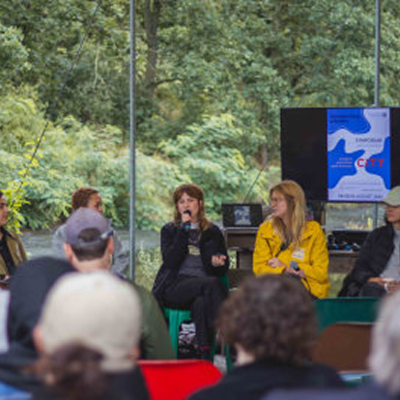
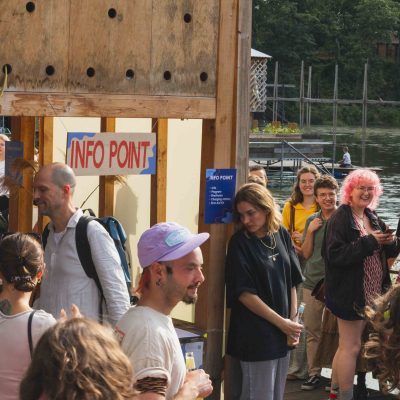
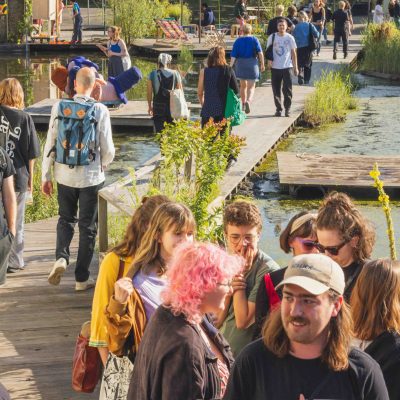
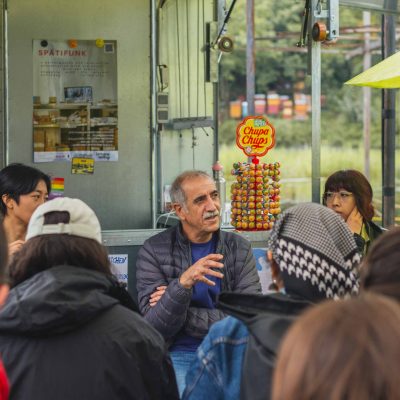
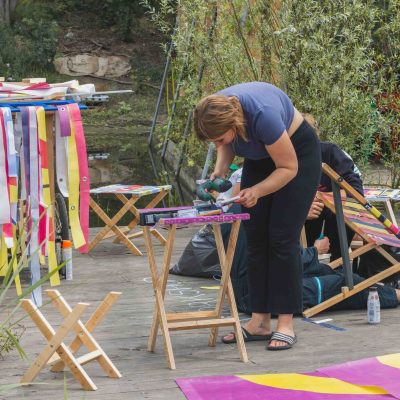
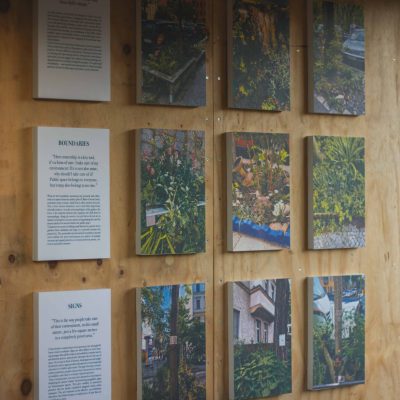
2023 Symposium
Sneak peek into the previous edition
Over three days in Berlin, the third edition brought together practitioners, researchers, and activists for an intense program of talks, workshops, and performances across the city.
500
participants
attended
70
contributions
3
days of intense program
Location info
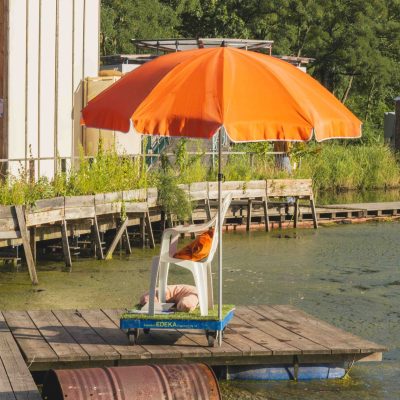
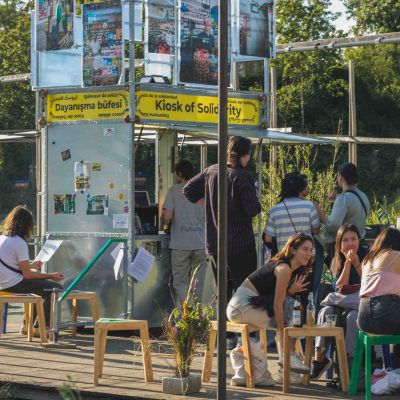
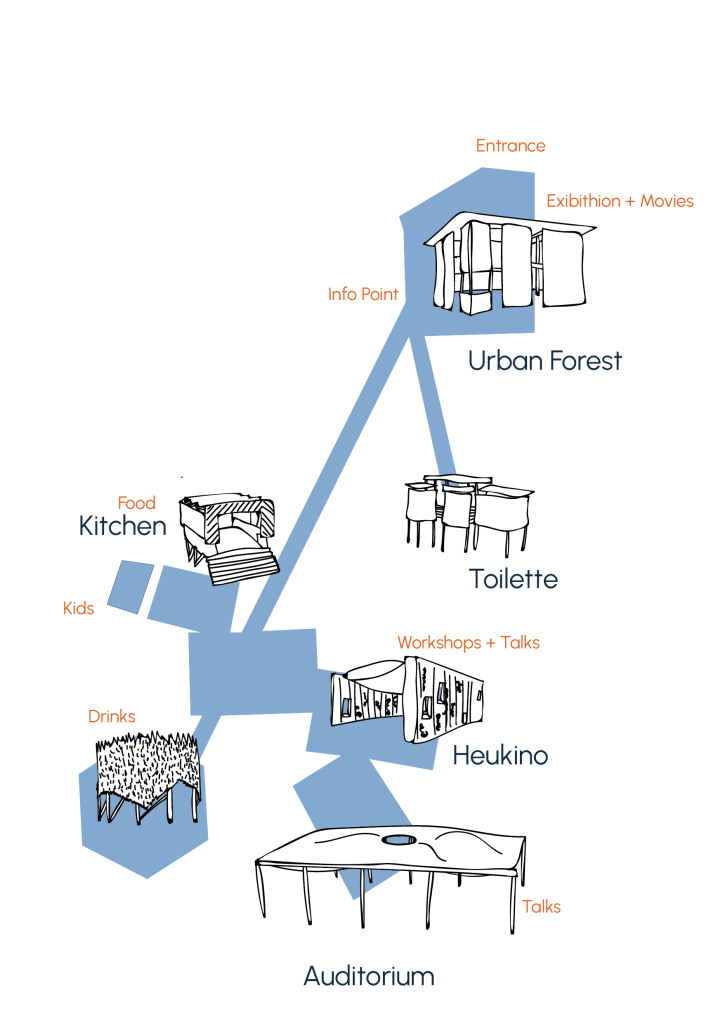
floating university
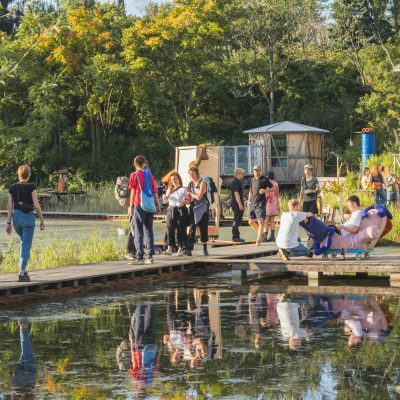
Floating e.V. is a self-organised space and group, where practitioners from a wide range of backgrounds meet to collaborate, co-create and imaginatively work towards futures. The site was designed in the 1930s as a rainwater retention basin and opened in 2018 as a cultural infrastructure.
Accessibility
Wheelchair access via ramps. Gender-neutral toilets throughout. Accessible to people with visual and motor impairments. Team members are available for support.
Getting there
floating universityLilienthalstr. 32
10965 Berlin
Ubahn Südstern